How my sculptures are created
 The first phase consists of finding a composition. Sometimes I sketch it on paper, other times I help myself with small clay models. Once I find a composition, I focus on capturing the atmosphere of the work. Only then can I start enlarging the model.
Because clay is a heavy material with a tendency to constantly settle, it is necessary to first weld the structure so that it does not get in the way while modeling and at the same time holds the clay well. I place the prepared scaffolding on a turntable so that the sculpture can be easily rotated and viewed from all angles. I then start applying clay to the structure and pound it well onto the scaffolding so that the clay holds well on the scaffolding.
The modeling itself then proceeds gradually. First, I apply the basic volumes, then I gradually refine the shape. I constantly step back from the sculpture, rotate it, and observe its overall tone. I often walk for miles because if I stand too close, I lose track of the overall atmosphere of the work.
 Modeling has several phases – from rough shapes to increasingly fine details. The key is to keep your distance and not fixate on the detail so that the whole appears harmonious and alive. It is also important to recognize the right moment to stop working on the sculpture. Too much precision can deaden the work and deprive it of lively modeling.
When I consider the work completed, the casting phase comes – which is an essential part of the process. Casting is physically demanding and requires thoughtful division of the mold so that it can be properly disassembled and reassembled. Each sculpture is unique and therefore always requires a unique approach.
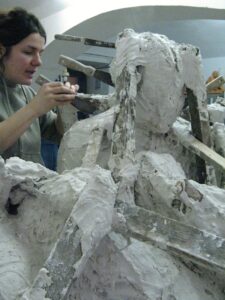 First, we divide the sculpture with dividing sheets, which create dividing planes. Then the first layer of plaster, colored blue, is applied, and then the next layers of plaster are no longer colored. The plaster can be reinforced with jute, wire or wooden reinforcements. Once the plaster mold is solidified, we can disassemble the mold. We insert the sieves into the dividing joints and slowly start pouring warm water into them. While very gently prying and pouring water, we gradually disassemble the mold. This phase requires patience – too much impatience can damage the mold.
Once the individual parts are disassembled and cleaned, a plaster positive can be created that exactly matches the original sculpture in clay. The mold can also be prepared for casting in resin. The plaster model is usually used as a preparatory model for the foundry, where a more complex silicone mold is created. The plaster model is separated and covered with lukoprene material, interspersed with a layer of wax. If we create a lukoprene shell, the mold is completed with a plaster core, which strengthens the mold.
 For casting in bronze, a wax model of the statue is first cast into a lukoprene mold. Drainage channels are also welded onto the model, also made of wax. The entire model, including the drainage channels, is poured into a plaster-clay mold and then fired in a kiln. The high temperature in the kiln causes all the wax to flow out, creating a space where the molten metal is then poured. After the metal has gradually cooled, the mold is broken and the casting is cleaned, chiseled, and welded. Finally, a patina is applied to the surface, which gives the sculpture its final appearance.
The whole process is time-consuming and costly. It requires not only precision and experience, but also enough patience so that the work does not lose its expression and tone. At each stage of the casting process, the desired atmosphere of the work can easily disappear.